
BBQ Alberta

Materials

Hail and Chinooks, Not the Coast: what survives, and what only looks like it will.

Almost every failure in this category traces back to one decision made badly: the wrong material, sold to the wrong address. Here is the whole picture, including where spending more buys you nothing.

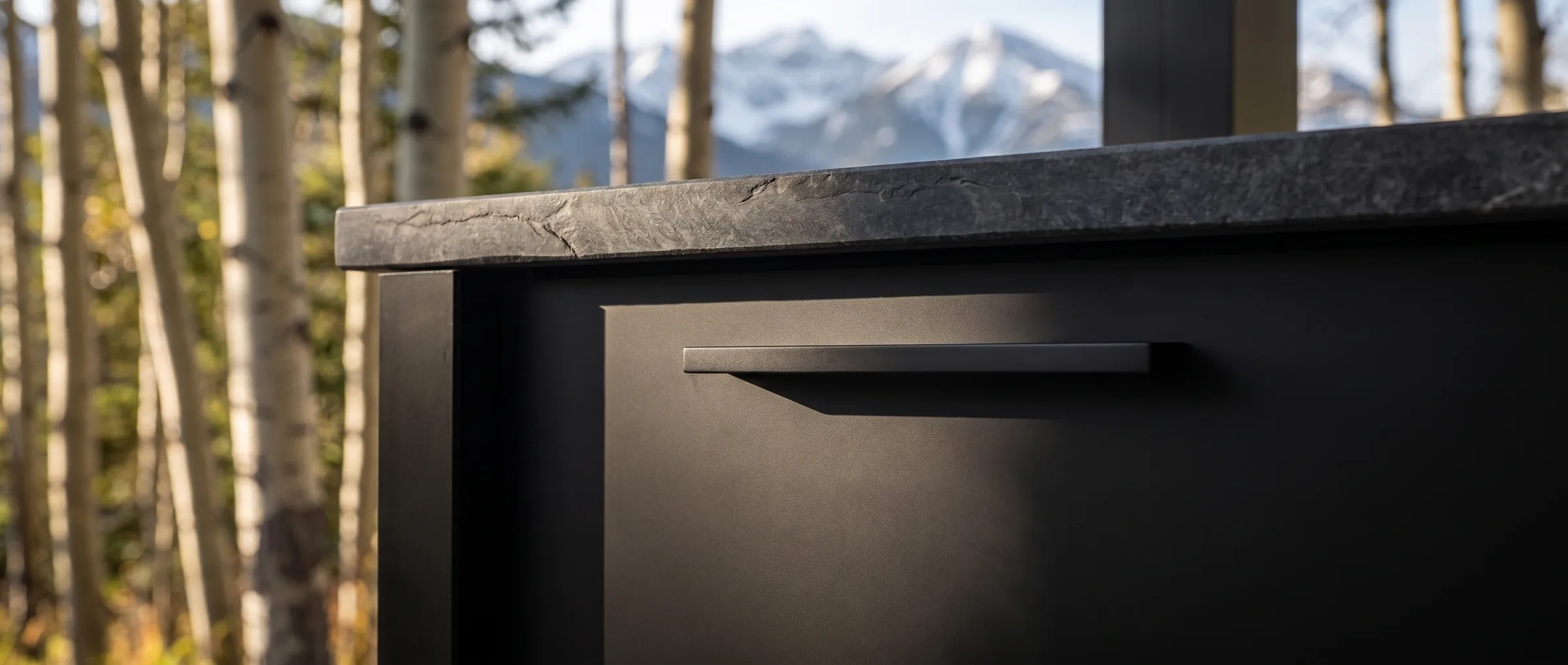
Close detail of a matte black cabinet front, recessed bar pull and dark stone counter edge

Cabinetry

304 stainless

Inland, covered, away from direct salt exposure

The industry default for good reason: strong, clean, repairable, and widely available in every appliance size you might want.

Within a mile of open salt water it pits and streaks, usually inside two seasons. Most rust complaints in this category are 304 that was sold where 316 belonged — which is why we only specify it where salt actually reaches the cabinetry.

Marine polymer (HDPE)

Full sun, direct exposure, pool decks

Genuinely inert. No rust, no rot, no corrosion, and it cleans up with soap. Excellent for door and drawer fronts.

It reads as plastic next to real stone or steel, and it expands and contracts in strong sun more than people expect. Detailing matters.

Powder-coated aluminium

Budget-conscious builds, covered areas

Will not rust. Light, quick to install, available in colours stainless cannot do.

It chips, and every chip is somewhere water sits. Honest about its limits inland; a poor bet on an exposed coastal deck.

316 marine-grade stainless

Waterfront and within roughly a mile of salt water

Molybdenum in the alloy resists chloride pitting. It is what boat decks and coastal railings are specified in, for exactly this reason.

Costs meaningfully more, and it is wasted money well inland. It is also only as good as its fasteners — 316 panels on 304 hinges will still streak.

Counters

Granite

Hard, heat-tolerant, forgiving. Still the default outdoors for a reason.

Porcelain slab

Almost zero absorption and excellent UV stability. Thin edges chip if the substrate is not right.

Limestone / shellstone

Beautiful and soft — it stains, and it needs sealing on a schedule. Worth knowing before it goes down, not after.

Concrete

Fully custom shapes and integrated sinks. Hairline cracks are part of the material, not a defect.

Which one is yours?

Every other BBQ Québec market is decided by water: salt air in Florida and Texas, freshwater freeze-thaw off the Great Lakes in Ontario. Alberta has neither ocean nor Great Lake — what decides a build here falls out of the sky instead of rising off a lake. Southern Alberta sits inside what insurers, meteorologists and researchers call Hailstorm Alley, the corridor running roughly from High River through Calgary and Airdrie north to Red Deer. It produced the two most expensive hailstorms in Canadian insurance history within four years of each other: $1.2 billion in insured damage on June 13, 2020, in a 10-to-15-minute storm with hail larger than softball size, and $3.25 billion on August 5, 2024 — the second-costliest disaster in Canadian insurance history, with 130,000-plus claims and roughly one in five Calgary homes hit. Chinooks matter too: temperature swings of 20 to 30°C in a few hours are routine, working concrete, grout and sealant far harder than a typical prairie winter — a maintenance question, not a structural one. And because there's no salt air, standard 304 stainless is correct for the overwhelming majority of Alberta builds; marine-grade 316 is reserved for a kitchen built within a few metres of a heavily salted arterial road. Gas hookups require a Safety Codes Act licensed Gasfitter – Class B.

Find out in sixty seconds